Aphasia Rehabilitation and Speech-Language Therapy Software | PowerAFA
Windows software for aphasia rehabilitation, neuro-linguistic disorders, language rehabilitation after stroke and speech-language therapy. Free demo, support in English, automatic updates.
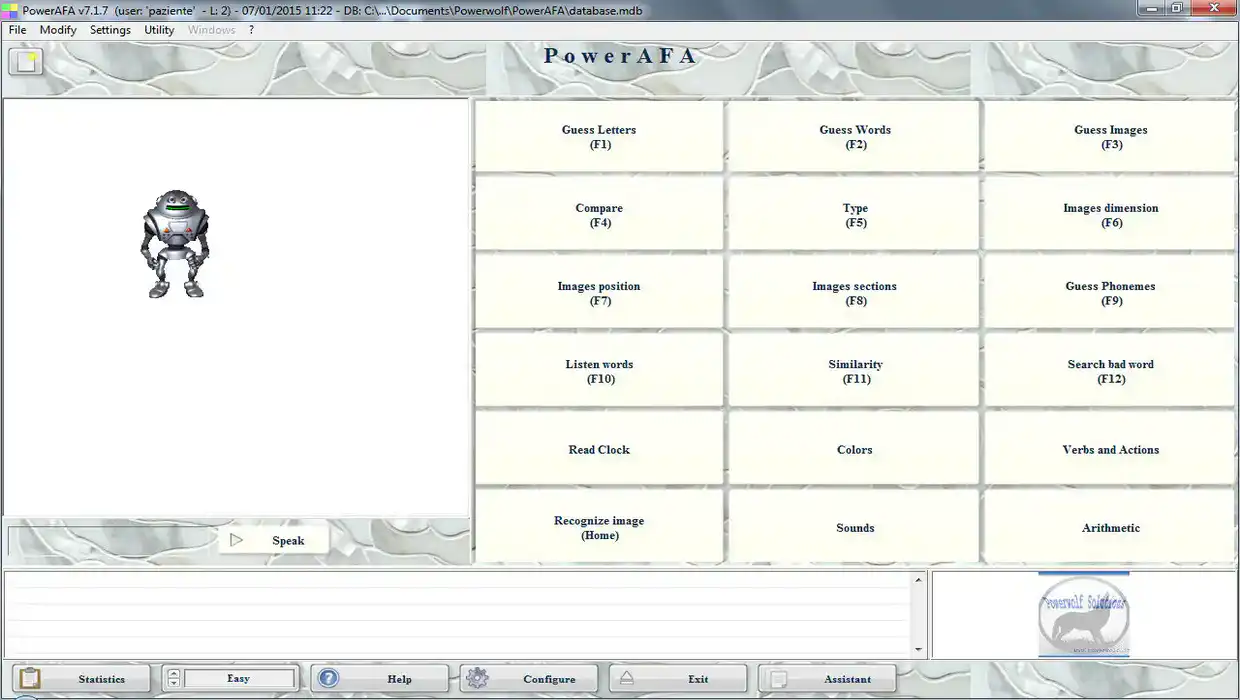
Aphasia Rehabilitation / Speech-Language Therapy
Customizable language exercises
What is aphasia?
Aphasia is a language disorder that may occur following brain damage, often caused by a stroke, head injury, or other neurological conditions. It can affect a person’s ability to understand words, speak, read, or write, even though their general cognitive abilities may remain intact.
People with aphasia may have difficulty finding the right words, forming sentences, understanding complex messages or communicating effectively in everyday life. The severity and type of difficulty depend on the brain area involved and the extent of the damage.
Aphasia treatment is primarily based on speech and language therapy, through targeted exercises aimed at supporting or improving language and communication skills. Digital tools such as PowerAFA can support the rehabilitation process by providing structured exercises for language, comprehension, and verbal production.
ℹ️ Communicate with a person with aphasia
Who is PowerAFA intended for?
PowerAFA was designed as a support tool for professionals and organizations working in language rehabilitation.
Main users:
- ✔️ Speech-language pathologists
- ✔️ Rehabilitation centers
- ✔️ Private practices
- ✔️ Hospitals and healthcare facilities
It can be used:
- ✔️ By patients as part of a rehabilitation program and, when necessary, under the supervision of a healthcare professional.
- ✔️ By family members and caregivers to support home exercises recommended by the speech-language pathologist or rehabilitation team.
What does PowerAFA do?
The application is based on the educational approach used in the Mayo Clinic worksheets and on the work described in ' language re-education ' by Robert L. Keith ( Omega edition ).
The software includes several exercises and is designed to support
people with aphasia
.
Over the years, PowerAFA has been used by patients, family members and professionals as part of
language rehabilitation after stroke
and
language rehabilitation
.
PowerAFA among the resources of the National Aphasia Association
PowerAFA is included among the resources published by the National Aphasia Association (NAA), a U.S. organization dedicated to aphasia information, support and awareness. The NAA has a dedicated page for the software describing its main features for language and communication rehabilitation.
🔗 View PowerAFA on the National Aphasia Association website
Scientific studies and reviews concerning PowerAFA
Below are selected scientific studies and rapid reviews on software-assisted aphasia rehabilitation. Only the first two studies specifically evaluate PowerAFA; the other sources provide broader scientific context.
-
De Luca et al. (2018) – Computerized Training in Poststroke Aphasia
Journal of Stroke and Cerebrovascular Diseases
“Computerized Training in Poststroke Aphasia: What About the Long-Term Effects? A Randomized Clinical Trial.” A randomized controlled study involving 32 patients with post-stroke aphasia. In this study, the authors reported statistically significant improvements in selected language and cognitive measures in the PowerAFA group compared with the control condition. -
De Luca et al. (2014) – Should individuals with chronic aphasia be treated with dedicated PC-based training? Considerations about a case study
PowerAFA was used in a clinical case study published in the scientific journal NeuroRehabilitation. The study reported improvements in the language, cognitive and communication skills of a patient with chronic aphasia, suggesting that the software may be a useful support alongside conventional rehabilitation. -
American Speech-Language-Hearing Association (ASHA) – (2026)
Rapid review of consumer-grade software for aphasia rehabilitation. It discusses digital tools and computer-assisted language therapy as rehabilitation support, while noting the need for additional large-scale randomized controlled trials to establish comparative effectiveness. -
National Library of Medicine / evidence on computer-based therapy (2023)
Evidence reviews of digital tools for speech-language therapy and language rehabilitation. The evidence supports computer-assisted therapy as a complement to traditional speech-language therapy, especially for increasing the intensity of language practice.
(Category: evidence review, not a primary study of PowerAFA.) -
American Heart Association Journals (2019) – Advances and Innovations in Aphasia Treatment Trials
Review of innovations in clinical trials for post-stroke aphasia treatment, including digital therapies, telerehabilitation and intensive multimodal approaches.
(Not specific to PowerAFA, but relevant as clinical context.)
Social media and reviews
Follow us on Facebook for news, software releases and other important updates.

The following testimonials describe individual experiences. Results may vary, and these statements should not be interpreted as clinical evidence or a guarantee of therapeutic outcomes.
⭐⭐⭐⭐½
Softpedia review - Mircea Dragomir
All things considered, we come to the conclusion that PowerAFA fully lives up to expectations and provides a powerful environment in which individuals can practice speaking, reading, writing and understanding of notions and actions.
⭐⭐⭐⭐⭐
Marcello A. - March 2023
Excellent program. My father, who suffered an ischemic stroke, has been using it for months with very good results.
⭐⭐⭐⭐⭐
Mark Kuchenbecker - April 2026
I am satisfied with PowerAFA software. It has improved my wife's communication in a simple and effective way.
⭐⭐⭐⭐⭐
Maurizio de Vincentis - November 2018
I purchased it a few years ago to help treat the effects of my father's stroke, and everything went well. My father used it willingly and even enjoyed it. Thank you.
Inspired by methods used in aphasia rehabilitation
Structured and customizable language exercises
Why choose PowerAFA?
- The software is a
support tool
for rehabilitation exercises and was developed with contributions from people with aphasia and
feedback from rehabilitation professionals and healthcare organizations
(the software does not replace standard clinical treatment);
- Free trial with no registration.
PowerAFA can be downloaded, installed and tested free of charge, with no purchase obligation;
- Automatic, free updates;
- Perpetual licenses.
No renewal fees. The purchase provides a perpetual license with no additional fees;
- Purchase with immediate activation.
The 2Checkout system sends the license as soon as payment is confirmed, with no waiting, phone calls or complex procedures;
ℹ️ Learn more about license management
- Purchase with multiple activations.
The purchase includes a license with multiple activations, allowing installation on several computers within the limit stated in the purchase information;
- Windows 32 / 64 bit.
The application is developed as native Windows software and does not require a browser or virtual machine;
- Protection and security.
The program can be protected with an access password and includes automatic database backup;
- Customizable interface including themes, fonts and display settings;
- Customizable screens and exercises;

The programs are distributed through digitally signed installers using certificates issued by certification authorities
GoGetSSL.com
and
DigiCert
.
The digital signature makes it possible to verify the installer’s authenticity, the publisher’s identity and the integrity of the distributed file.
🛡️ View the VirusTotal scan reports for our installers.
Scientific evaluations
🧠 Clinical reviews and papers :
📄 Evidence concerning computer-assisted aphasia rehabilitation (scientific review).
An ASHA rapid review examined consumer-grade software used in aphasia rehabilitation. It reported positive findings
for some digital interventions, while also identifying limitations in the available evidence. The review should not be interpreted
as an independent clinical validation of every included product.
📄 Review of rehabilitation software for aphasia (
ASHA - 2026
).
The review reported positive findings for some interventions and outcomes,
while also identifying limitations in the available evidence:
- language;
- functional communication;
- aphasia severity.
📄 Clinical study on
ScienceDirect
(August 2018):
Study of post-stroke patients: PowerAFA versus conventional therapy.
👉 Reported results:
- significant improvements in language and cognitive functions;
- results maintained at the three-month follow-up;
- greater improvement than the control group on some measures.
PowerAFA features and objectives
PowerAFA is designed to support language rehabilitation activities. It does not replace clinical assessment, speech-language therapy or a treatment program defined by healthcare professionals, but it can complement rehabilitation exercises and reinforce activities performed during therapy.
When necessary under the supervision of a healthcare professional, the software can support the following areas:
- Aphasia rehabilitation
- Structured language practice after stroke
- Support for speech-language therapy
- Support for people with aphasia
- Neuro-linguistic disorders
- Language rehabilitation
- Computer-assisted therapy
- Speech-language therapy software available in English, French, German, Italian and Spanish
- Aphasia exercises
- Post-stroke rehabilitation exercises
- Acquired language impairments
- Recovery after ischemic stroke
- Support for language rehabilitation programs
ℹ️ Learn more about the types of aphasia
Changelog | Recent changes
The following are the main changes recently made to the software:
-
Version 10.2.1 - June 11, 2026
- Fixed several issues in some exercises;
- Export to Excel format without requiring Microsoft Excel
-
Version 9.2.1 - February 10, 2026
- Improvements to the main window;
- Improvements to the English localization of the software
-
Version 9.1.1 - December 27, 2025
- Visual improvements to the exercise screens
-
Version 7.6.4 - December 21, 2025
- Exercise customization feature
-
Version 1.0.0 - May 23, 2007
- First official release
Benefits of PowerAFA
Free updates | Interface in English, French, German, Italian and Spanish
Frequently asked questions (FAQ)
Question
: What is PowerAFA and who is it intended for?
Answer
: PowerAFA is Windows software designed to support aphasia rehabilitation and recovery of communication skills after neurological events such as stroke. It is intended for speech-language pathologists, rehabilitation professionals and, when recommended by a professional, individual practice.
Question
: Can I try PowerAFA before purchasing it?
Answer
: Yes. A free demo is available.
Question
: Is a monthly subscription required?
Answer
: No. The software can be purchased with a perpetual license.
Question
: What exercises are included in PowerAFA?
Answer
: PowerAFA includes exercises targeting language and cognitive skills involved in aphasia, including comprehension, naming, word-image association, language production and other customizable rehabilitation activities.
Question
: Can PowerAFA replace speech-language therapy?
Answer
: No. PowerAFA is a rehabilitation support tool that can be integrated into a speech-language therapy program. Assessment and therapeutic goals must be defined by a qualified professional.
Question
: Has PowerAFA been evaluated in scientific research?
Answer
: A randomized clinical study published in 2018 evaluated the use of PowerAFA in a group of people with post-stroke aphasia. Other publications cited on this page concern computer-assisted aphasia rehabilitation more generally and should not be interpreted as direct evaluations of PowerAFA.
Question
: Which operating systems support PowerAFA?
Answer
: PowerAFA is available for Windows and can be used on computers compatible with the operating systems supported by the software.
Question
: Can patients use PowerAFA at home?
Answer
: Yes. When recommended by a professional, PowerAFA can also be used for home practice to support continuity between therapy sessions.
Question
: Where is PowerAFA data stored and how is privacy protected?
Answer
: All data is stored locally on the user’s computer and is not transferred to or stored on cloud services. The information therefore remains under the direct control of the user or organization using the software.
How much does PowerAFA cost?
PowerAFA is available in three editions based on the number of patients managed. Each edition can be purchased with annual renewal or as a perpetual license.
PowerAFA Base (1 patient)
• Annual renewal:
€30.00
• Perpetual license:
€65.00
PowerAFA Professional (up to 10 patients)
• Annual renewal:
€60.00
• Perpetual license:
€135.00
PowerAFA Ultimate (more than 10 patients)
• Annual renewal:
€150.00
• Perpetual license:
€300.00
Prices exclude VAT
👉
Proceed to purchase
📄
Purchase terms
💬
Questions? Contact us
PowerAFA: a story of commitment and innovation
Development of PowerAFA began in 2007 after a personal experience transformed a family difficulty into a project dedicated to supporting people with aphasia.
After the stroke suffered by the father of Antonio de Francesco , which resulted in aphasia, Antonio began developing exercises intended to support the rehabilitation process.
The exercises were initially inspired by material in a Mayo Clinic book recommended by the therapist overseeing the recovery program. From this foundation, through study, experimentation and attention to patients’ real needs, PowerAFA was gradually developed as a digital tool intended to make language rehabilitation exercises more accessible and structured.
PowerAFA therefore grew from the combination of personal experience, technology and attention to people undergoing recovery after a neurological event.
The software is developed and distributed by PowerWolf Software Solutions .
The software is developed for Windows. The core application is based on LabVIEW by National Instruments , a platform widely used for developing data acquisition systems and engineering applications.
Some additional components and supporting libraries are developed using Microsoft Visual Studio , the development environment from Microsoft .
Project history and development
2007 - Development of PowerAFA begins with the goal of creating a software tool to support aphasia and language-disorder rehabilitation.
2007 - Present - The software is progressively expanded and updated based on practical experience, feedback from patients and professionals, and the introduction of new features.
2010 - Introduction of avatars and animated assistants.
2013 - Implementation of webcam-based visual feedback and introduction of new speech synthesizers.
Present - PowerAFA is continuously maintained and improved to support newer versions of Windows.
Available since 2007
Free updates included
About us
PowerAFA is developed by Antonio de Francesco .
The project began in 2007 and is currently distributed by PowerWolf Software Solutions .


PowerAFA is developed for Windows and is available in English, French, German, Italian and Spanish, using professional software development tools. The core application is built with LabVIEW by National Instruments , a platform widely used for developing data acquisition systems and engineering applications.
Some components and supporting modules are developed using Microsoft Visual Studio , the integrated development environment from Microsoft .
Environmental impact and responsible use
PowerAFA is distributed digitally, without packaging, printed manuals or physical installation media.
PowerAFA can run on standard Windows computers already used by organizations or private users and does not require dedicated hardware. Its actual environmental impact depends on usage patterns, the computer used and energy consumption.
Help and contact
For more information:
You can arrange a telephone appointment with one of our consultants to learn about the software’s features and receive information about purchasing, payment methods and other aspects of PowerAFA.

Acknowledgements
We would like to thank the following people for their valuable contributions during the early stages of software development:
A practical example

An example of the software being used with patients affected by neurological conditions was published on the IRCCS Messina website on November 13, 2024:
🔗
Advanced cognitive neurorehabilitation
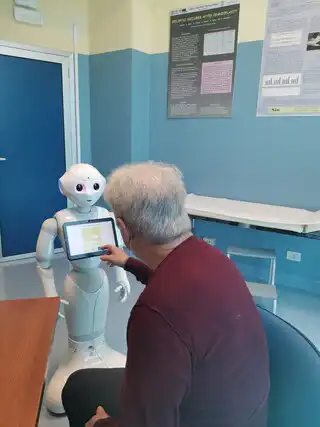
PowerAFA installed on a Windows tablet
Further scientific evidence on PowerAFA
PowerAFA included in the NICE Evidence Review
PowerAFA is included in the Evidence Review K – Computer-based tools for speech and language therapy by the National Institute for Health and Care Excellence (NICE), published as part of the NG236 – Stroke rehabilitation in adults guideline.
The NICE review examines the available evidence on the use of computer-based tools for language rehabilitation in people with post-stroke aphasia and includes the randomized controlled trial by De Luca et al. (2018), in which PowerAFA was used by the group undergoing computerized training.
The study considered by NICE involved 32 patients with aphasia: 17 received training with PowerAFA combined with conventional rehabilitation, while 15 received conventional therapy alone. PowerAFA is also listed in the review among the examples of computer-based tools available for aphasia treatment.
PowerAFA cited in Frontiers in Human Neuroscience
PowerAFA is cited in the scientific review "Transcranial Direct-Current Stimulation and Behavioral Training, a Promising Tool for a Tailor-Made Post-stroke Aphasia Rehabilitation", published in 2021 in the journal Frontiers in Human Neuroscience.
The review, which focuses on strategies for post-stroke aphasia rehabilitation, examines different rehabilitation approaches and the use of digital and computer-based tools to support language therapy.
Among the rehabilitation protocols based on computerized exercises, the review cites PowerAFA, described by the authors as an Italian software program providing phonological, semantic, orthographic, morphological and syntactic exercises with increasing levels of difficulty. The review refers to the clinical study by De Luca et al. (2018) on the use of PowerAFA in post-stroke aphasia rehabilitation.